

Recreational Diving Impacts and Coral Reef Management in Palau
Koror State Government, Department of Conservation and Law Enforcementt | 2003
Project Overview
Palau is internationally renowned for its exceptional coral reefs and world-class scuba diving. The Rock Islands Southern Lagoon supports many of the country’s most popular diving destinations, attracting visitors from around the world and generating substantial economic benefits.
However, the growth of recreational diving raised concerns about the potential impacts of tourism on sensitive marine habitats. Physical contact with coral reefs, boat traffic, anchoring and overcrowding were recognised as potential threats, yet limited scientific information was available to guide the management of individual dive sites.
In 2003, Community Centered Conservation (C3) undertook a programme of biological surveys and diver-impact assessments for Koror State Government, supported by the U.S. National Fish and Wildlife Foundation.
The project combined quantitative coral reef monitoring, direct underwater observations of recreational divers and consultation with tourism operators to assess the condition of popular dive sites and identify practical options for reducing environmental impacts.
The research focused on three prominent diving destinations: German Channel, Ngerchong and Big Drop-off.
Findings were presented in C3 Technical Report Series No. 1 in 2003 and subsequently developed into a peer-reviewed scientific paper published in Pacific Science in 2010.
Activities
Establishing Ecological Baselines at Major Dive Sites
C3 conducted underwater biological assessments at German Channel, Ngerchong and Big Drop-off, selected in consultation with Koror State Government because of their popularity, environmental characteristics and management needs.
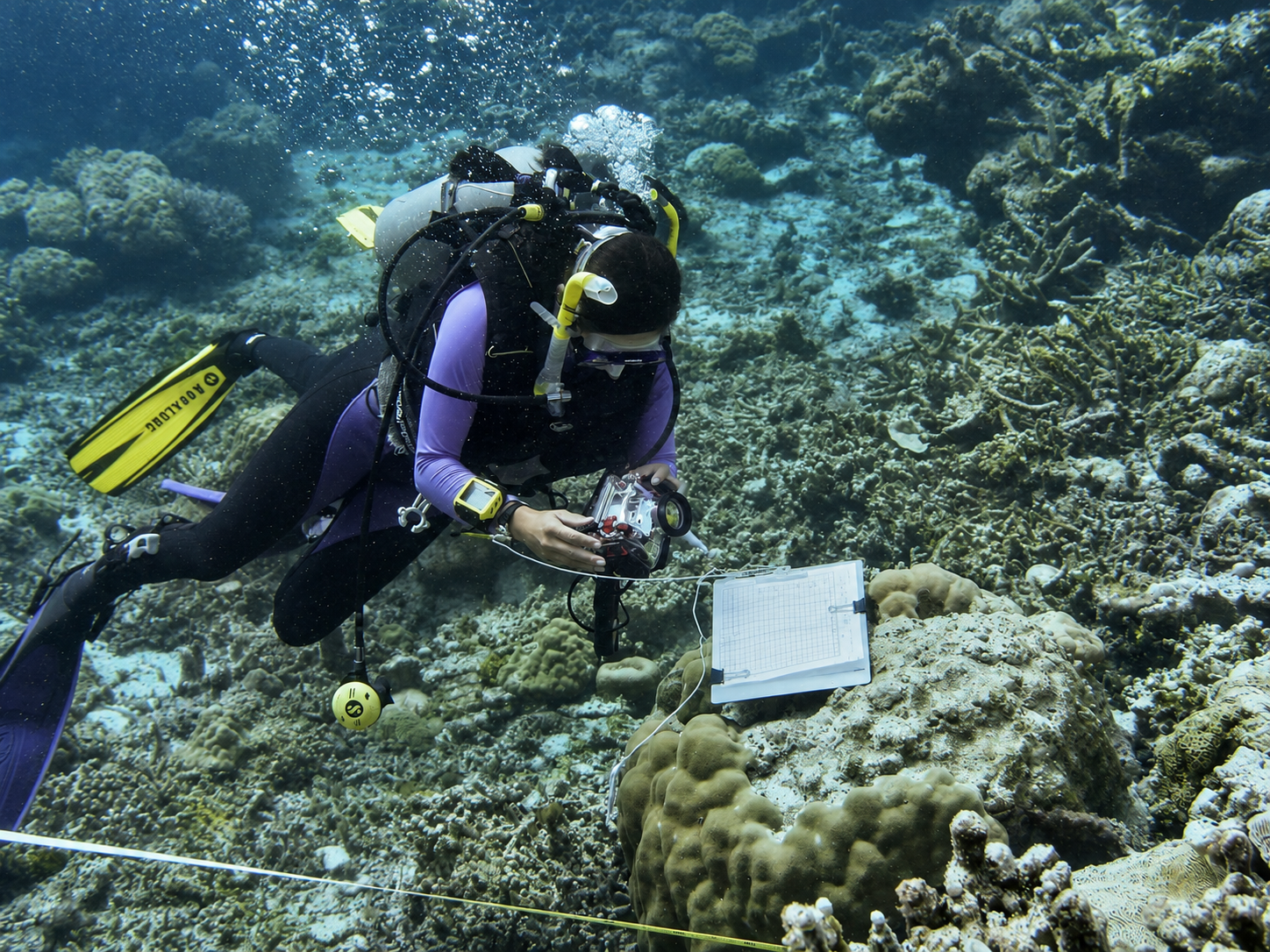
The fieldwork included underwater fish counts, assessments of reef substrate composition and documentation of coral reef condition.
At German Channel and Ngerchong, researchers conducted transect-based fish surveys and point-intercept assessments of coral and other benthic habitats.
These surveys established baseline information on coral cover, fish communities and the condition of different reef habitats, including areas previously affected by the severe 1997–1998 coral bleaching event.
The results provided context for distinguishing physical impacts associated with tourism from damage arising from natural disturbances.
Quantifying Recreational Diver Behaviour
C3 researchers followed recreational scuba divers underwater to observe how frequently they came into contact with coral and other reef substrates.
Observations recorded the type of contact, including fin strikes, holding onto coral, kneeling, contact with diving equipment and visible physical damage.
The studies also examined whether particular equipment or activities, such as wearing gloves or using underwater cameras, were associated with increased contact rates.
Each selected diver was observed for a standardised ten-minute period, allowing comparisons between sites and different types of diver behaviour.
Assessing Differences Between Dive Sites
The research compared diver interactions across three contrasting underwater environments.
German Channel, a popular location for observing manta rays and other large marine species, recorded the highest average rates of contact with hard coral.
Ngerchong, where substantial areas of reef had been affected by earlier coral bleaching, experienced intermediate contact rates.
Big Drop-off, a steep reef wall, recorded the lowest rates of contact with hard coral among the three sites.
These differences demonstrated the importance of considering reef topography, diver behaviour and site-specific conditions when developing management measures.
Consulting Dive Guides and Tourism Operators
Alongside underwater research, C3 gathered information from professional dive guides concerning reef condition, environmental impacts and tourism management.
Questionnaires were distributed in English and Japanese, with responses received from 35 guides representing 18 tourism companies, as reported in the subsequent peer-reviewed publication.
The consultation explored perceptions of coral damage, the causes of reef degradation, diving activity and overcrowding, and the effectiveness of existing management practices.
Tourism operators highlighted concerns about boat and diver congestion, particularly at German Channel, while also acknowledging the potential impacts of recreational diving on coral reefs.
Developing Management Recommendations
Drawing on the biological surveys, diver observations and stakeholder consultation, C3 prepared recommendations for improving the environmental management of recreational diving within the Rock Islands Southern Lagoon.
Proposed measures included:
- Long-term monitoring of reef condition, coral damage and diving activity.
- Greater involvement of dive guides and tourism operators in environmental monitoring.
- Improved environmental briefings, supervision and professional training for guides.
- Controls on damaging practices, including the use of gloves and inappropriate underwater contact.
- Measures to manage boat traffic, overcrowding and other site-specific pressures.
- Improved communication and cooperation between government authorities and the tourism industry.
- Additional conservation training for Koror State Rangers.
These recommendations sought to balance the economic importance of marine tourism with the protection of Palau’s coral reef ecosystems.
Publishing the Research
The original findings were documented in C3’s 2003 technical report, Baseline Biological Surveys and Threat Assessment of Dive Sites in Koror State, Palau.
The diver-impact research was subsequently developed into a scientific paper by Chris Poonian, Patricia Davis and Colby Kearns McNaughton.
Published in the peer-reviewed journal Pacific Science in 2010, the paper examined the relationship between recreational diving behaviour, coral contact rates and options for management.
The publication extended the relevance of the research beyond Palau, providing evidence applicable to other coral reef tourism destinations and marine protected areas.
Key Results
The project generated quantitative evidence of recreational diving impacts and established ecological baseline information for three of Palau’s important dive sites.
- Three major dive sites assessed: German Channel, Ngerchong and Big Drop-off.
- 124 recreational divers observed in the dataset reported in the 2010 peer-reviewed paper, each during a standardised ten-minute observation.
- 35 dive-guide questionnaires completed, representing 18 tourism companies.
- Hard coral contact rates varied substantially between dive sites, averaging 2.98 contacts per diver per ten minutes at German Channel, 1.86 at Ngerchong and 0.87 at Big Drop-off.
- Divers wearing gloves contacted hard coral significantly more frequently, averaging 4.1 contacts per ten minutes compared with 1.3 among divers not wearing gloves.
- Underwater photographers also showed higher average contact rates, although the difference was not statistically significant.
- Three instances of obvious physical coral damage were recorded during the underwater observations, caused by two divers.
- Coral reef baseline surveys documented important differences in habitat condition, including substantial damage associated with the 1997–1998 bleaching event at Ngerchong.
The research demonstrated that while most individual coral contacts did not produce immediately visible physical damage, repeated interactions could contribute to cumulative pressure on heavily visited reefs.
It also highlighted the need to distinguish diving-related impacts from damage caused by bleaching and other environmental disturbances.
Lasting Impact
C3’s research provided Koror State Government with ecological baseline data and practical recommendations for managing recreational diving in the Rock Islands Southern Lagoon.
By integrating field surveys with observations of visitor behaviour and consultation with tourism operators, the project demonstrated how scientific evidence could inform sustainable tourism management.
The research also reinforced the importance of professional tour guide training, supporting the rationale for Koror State’s Marine Tour Guide Certification Programme, for which C3 separately developed training materials.
Publication of the findings in Pacific Science in 2010 extended their contribution to international understanding of recreational diving impacts and the management of coral reef tourism.
The study highlighted an enduring conservation challenge: ensuring that economically valuable marine tourism can continue without undermining the ecosystems on which it depends.
For C3, the project represents an early example of combining marine ecological monitoring, applied research, stakeholder consultation and technical advice for government — expertise that continues to be reflected across the C3 Global Network.
Technical Reports & Publications
Poonian, C., Davis, P.Z.R. and Kearns McNaughton, C. (2010). Impacts of Recreational Divers on Palauan Coral Reefs and Options for Management. Pacific Science, 64(4), 557–565.
Contact:
Connect with the C3 Global Network
We welcome enquiries from governments, international organisations, research institutions, conservation partners and private-sector organisations interested in our work.
Our network combines community-centred conservation programmes in Fiji, Madagascar and the Philippines with specialist marine environmental research and consultancy services worldwide.
Whether you are exploring a new partnership, seeking technical expertise or interested in our historical research and publications, we would be pleased to hear from you.
C3 Global Network brings together independently registered conservation organisations and environmental consultancy services.
Community Centred Conservation (C3) is registered as a non-profit company in England & Wales with company number 5606924.