
Marine Tour Guide Certification and Sustainable Tourism in Palau
Koror State Government, Department of Conservation and Law Enforcementt | 2003–2005
Project Overview
Palau’s internationally renowned marine environment, particularly the coral reefs, marine lakes and limestone islands of the Rock Islands Southern Lagoon, provides the foundation for a major tourism industry. However, increasing numbers of visitors and marine recreational activities were creating growing pressures on its natural and cultural resources.
In the early 2000s, marine tour guides working in Koror State were not required to undertake standardised local training in environmental conservation, cultural heritage or sustainable tourism practices. Although many guides held professional diving qualifications, their knowledge of Palau’s unique marine ecosystems, environmental legislation and cultural traditions varied considerably.
In June 2003, Koror State Government commissioned Community Centered Conservation (C3) to develop the course content for a proposed Marine Tour Guide Certification Programme. The initiative formed part of the wider management planning process for the Rock Islands Southern Lagoon, with the aim of reducing tourism impacts while strengthening the professionalism of the local tourism industry.
C3’s assignment began with stakeholder consultations to identify training requirements and subsequently involved developing educational materials covering marine ecology, environmental protection, Palauan culture, visitor safety and professional guiding practices.
The resulting manual, originally published in 2005, became a foundation for subsequent editions of Koror State’s tour guide training materials.
Activities
Stakeholder Consultation and Training Needs Assessment
C3 began by assessing the needs, experiences and views of marine tourism operators and guides working in Koror State.
In June 2003, questionnaires were distributed to 25 marine tour companies operating in the Rock Islands area. The questionnaires were prepared in English, Japanese and Taiwanese-language versions to accommodate the multilingual tourism workforce.
The assessment collected information on guide qualifications, professional experience, recreational activities, customer profiles, existing environmental briefings and preferred training arrangements.
C3 also conducted face-to-face interviews with representatives of nine tourism companies, exploring their views on environmental education, cultural heritage, legislation, safety responsibilities and certification requirements.
The consultation process generated 36 completed questionnaires from guides employed by 18 companies, providing a practical evidence base for designing the proposed certification programme.
Identifying Training Priorities
The 2003 consultations revealed broad support for establishing minimum standards of knowledge and professional practice among marine tour guides.
Although approximately 75% of the guides surveyed held professional diving qualifications, operators recognised the need for more comprehensive training in Palau-specific environmental and cultural subjects.
Tour operators reported frequent visitor questions about marine ecology, environmental regulations and Palauan culture and history. The consultations highlighted the value of a reference manual that guides could use to communicate accurate information to visitors.
Recommendations included:
- Training in marine ecosystems, conservation, cultural heritage, environmental legislation and tour operator responsibilities.
- Course materials accessible to Japanese- and Taiwanese-speaking guides.
- Optional first aid and cardiopulmonary resuscitation (CPR) training.
- Training scheduled during the quieter tourism season.
- Short evening sessions, generally no longer than two hours, within a course lasting a maximum of two weeks.
These findings informed the proposed curriculum and the development of subsequent training materials.
Developing the Marine Tour Guide Certification Manual
Building on the consultations, C3 compiled a comprehensive reference manual for Koror State Government, drawing upon scientific literature, government regulations, industry consultation and technical contributions from organisations working in Palau.
The original manual, published in 2005, brought together eight principal subject areas:
- Palau’s geography, society and tourism industry.
- Professional tour guiding and visitor management.
- Marine ecosystems, biodiversity and conservation.
- Traditional and contemporary Palauan culture.
- Palauan history and culturally significant sites.
- Human safety, diving emergencies and first aid.
- Water safety and boating regulations.
- Environmental legislation and sustainable tourism practices.
The resource was designed to provide guides with practical knowledge that could be communicated to visitors while promoting compliance with local conservation regulations.
Promoting Responsible Marine Tourism
Environmental protection was a central component of the manual.
C3 incorporated guidance on responsible diving and snorkelling, avoiding damage to coral reefs, respecting marine wildlife, preventing marine pollution and minimising impacts on sensitive habitats.
The manual introduced guides to Palau’s marine biodiversity, including coral reefs, mangroves, seagrass beds, marine lakes, sharks, sea turtles and dugongs.
It also explained the role of protected areas, conservation legislation and local resource-management practices, helping guides understand their responsibilities as both tourism professionals and stewards of the marine environment.
Integrating Cultural Heritage and Environmental Management
C3 recognised that sustainable tourism required more than knowledge of marine ecology.
The manual also addressed Palau’s history, cultural heritage, traditional governance, customary practices and the significance of historical and archaeological sites.
By integrating these subjects with environmental management and professional guiding skills, the resource was intended to improve the quality and accuracy of information provided to visitors while promoting respect for Palau’s natural and cultural heritage.
Supporting Multilingual Training and Programme Development
Palau’s tourism workforce served visitors from several international markets, and many guides were more comfortable communicating in languages other than English.
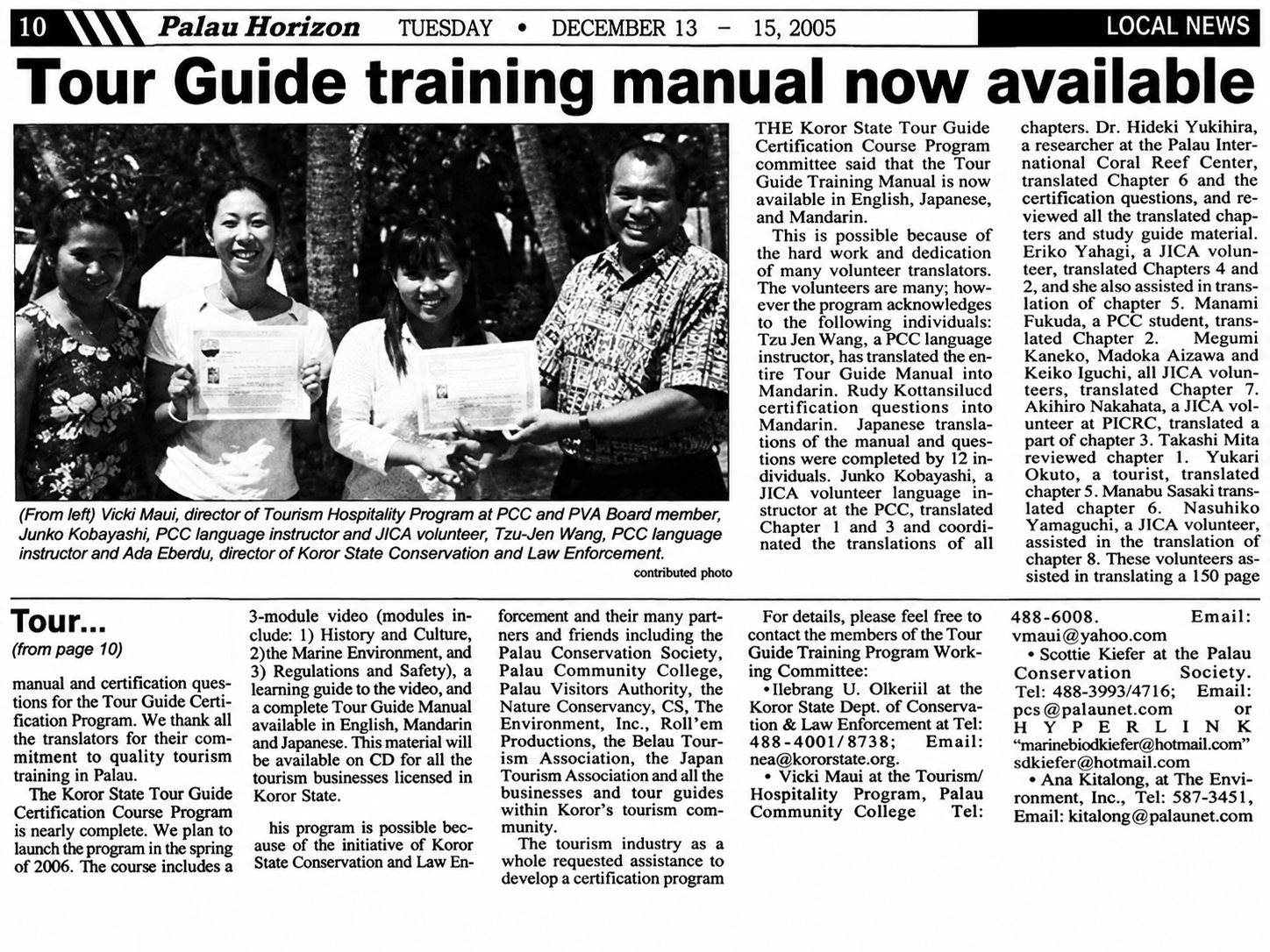
The original manual became available in English, Japanese and Mandarin through collaboration with local institutions and volunteer translators.
Its publication was reported in the Palau Horizon in December 2005, providing contemporary documentation of the initiative.
A revised second edition followed in 2007, expanding and updating the training materials.
Key Results
C3’s consultancy produced a series of documented outputs supporting the development of Koror State’s Marine Tour Guide Certification Programme.
- 25 marine tourism companies approached during the 2003 consultation process.
- 36 completed questionnaires received from guides representing 18 companies.
- Nine face-to-face company interviews conducted to assess training needs and practical implementation requirements.
- Multilingual stakeholder consultation materials prepared to improve participation among guides from different language backgrounds.
- A stakeholder consultation report published as C3 Technical Report Series No. 2 in 2003.
- A comprehensive Marine Tour Guide Certification Manual developed and published in 2005.
- Training materials made available in English, Japanese and Mandarin, supporting wider accessibility.
- A revised second edition published in 2007, building on the original training resource.
The original manual combined scientific information, cultural heritage, safety guidance and environmental regulations into an integrated reference resource for Palau’s marine tourism industry.
Lasting Impact
C3’s contribution extended well beyond the initial preparation of the training manual.
The original resource developed by Patricia Davis and Colby Kearns in 2005 was followed by a revised second edition in 2007.
In 2015, Koror State Government published a substantially expanded edition of the Tour Guide Training and Certification Program Manual. This later edition explicitly acknowledged Davis and Kearns of Community Centered Conservation as the developers of the original manual.
The 2015 publication, produced by a wider team led by other organisations and specialists, incorporated expanded information on marine and terrestrial biodiversity, cultural heritage, environmental legislation and the management of the Rock Islands Southern Lagoon, which had been inscribed as a UNESCO World Heritage Site in 2012.
The continued development of the manual demonstrates how C3’s early consultancy provided a foundation for a longer-running government training initiative.
More broadly, the project illustrates the importance of combining stakeholder engagement, scientific knowledge, environmental education and practical training in developing sustainable tourism standards.
For C3, the assignment was an early example of working directly with government to translate conservation science into practical tools for environmental management, professional capacity building and sustainable economic activity.
Technical Reports & Publications
Davis, P.Z.R. and Kearns, C.M. (2005). Koror State Government Marine Tour Guide Certification Manual. Prepared by Community Centered Conservation (C3) for Koror State Government.
Koror State Government (2015). Tour Guide Training and Certification Program Manual. Expanded edition acknowledging C3’s authorship of the original manual.
Contemporary media coverage: Palau Horizon, 13–15 December 2005. “Tour Guide training manual now available.”
Contact:
Connect with the C3 Global Network
We welcome enquiries from governments, international organisations, research institutions, conservation partners and private-sector organisations interested in our work.
Our network combines community-centred conservation programmes in Fiji, Madagascar and the Philippines with specialist marine environmental research and consultancy services worldwide.
Whether you are exploring a new partnership, seeking technical expertise or interested in our historical research and publications, we would be pleased to hear from you.
C3 Global Network brings together independently registered conservation organisations and environmental consultancy services.
Community Centred Conservation (C3) is registered as a non-profit company in England & Wales with company number 5606924.