

Dugong Conservation and Seagrass Habitat Research in Palau
The Nature Conservancy, Palau Conservation Society, Palau International Coral Reef Center, Koror State Government | 2002–2004
Project Overview
Palau supports an exceptionally isolated population of dugongs (Dugong dugon), making their long-term survival particularly vulnerable to hunting, habitat degradation and other human pressures. In the early 2000s, limited information was available about the animals’ distribution, feeding habitats and movements, restricting the development of effective conservation measures.
Community Centered Conservation (C3), established in Palau in April 2002, initiated a multidisciplinary research programme to improve understanding of dugong ecology and the seagrass habitats on which the species depends.
Working with local government agencies, researchers and conservation organisations, C3 combined underwater seagrass surveys, interviews with experienced fishers, community-based sightings records, aerial survey participation and investigations of dugong mortality.
The work initially concentrated on Malakal Harbour and Ngederrak Reef in Koror State, an area of significant ecological importance exposed to intensive boat traffic and coastal development pressures.
C3 subsequently contributed to a wider national dugong assessment coordinated by The Nature Conservancy, culminating in a comprehensive technical report on the status and management of dugongs in Palau.
Activities
Mapping Seagrass Feeding Habitats
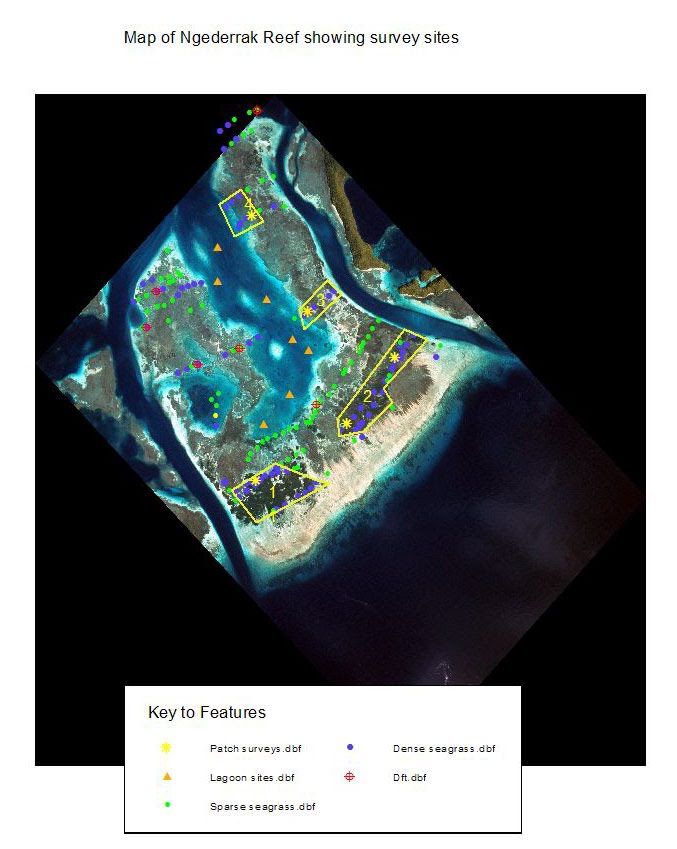
Between October 2002 and April 2003, C3 conducted underwater surveys of the seagrass communities surrounding Ngederrak Reef.
Researchers used manta tows, GPS positioning, underwater transects and quadrat sampling to investigate seagrass distribution, species composition and percentage cover. Survey observations were integrated with georeferenced aerial photography and GIS mapping to identify important habitat areas.
The surveys included the shallow reef flat and deeper lagoon habitats, where divers investigated seagrass communities that could not be adequately assessed using aerial observations alone.
Particular attention was given to locating dugong feeding trails and identifying the seagrass species associated with feeding activity.
Incorporating Local Ecological Knowledge
C3 interviewed knowledgeable fishers and former dugong hunters to investigate historical and contemporary dugong distribution, behaviour and feeding patterns.
Interviews explored changes in sightings, hunting practices, movements between habitats and the potential influence of increasing boat traffic.
This information complemented ecological survey data and helped identify areas requiring additional research and protection.
Establishing Dugong Sightings Records
In 2002, C3 established a network for recording incidental dugong sightings involving dive operators, conservation officers, researchers and other local participants.
Standardised recording forms and marine charts were distributed to participating organisations, allowing sightings and observations of dugong behaviour to be documented.
The information collected was subsequently transferred to Palau Conservation Society to contribute to a longer-term national sightings database.
Investigating Dugong Mortality
C3 worked with government wildlife officers and scientific collaborators to examine two dugong carcasses recovered in December 2002 and March 2003.
The investigations included biological measurements and collection of tissue and stomach-content samples. Material was provided to collaborating researchers in Australia for genetic and dietary investigations.
These studies contributed information on dugong feeding ecology and highlighted the potential consequences of human-related mortality for Palau’s vulnerable population.
Contributing to National Surveys and Conservation Planning
C3 participated in the March 2003 national aerial survey coordinated by The Nature Conservancy, alongside government agencies and conservation organisations.
Patricia Davis, working through C3, was also contracted by The Nature Conservancy to analyse historical and recent aerial survey data and prepare a comprehensive assessment of Palau’s dugong population.
Published in 2004, this report integrated aerial surveys, local ecological knowledge, seagrass habitat assessments, sightings records and conservation legislation to provide recommendations for future research and management.
Community Awareness and Capacity Building
The project included public lectures, radio discussions, newspaper coverage and educational field activities.
School, college and university students participated in research activities, gaining practical experience in marine ecological monitoring and conservation.
C3 also communicated the importance of protecting dugongs and their feeding habitats, particularly in areas affected by heavy vessel traffic.
Key Results
The research produced important new evidence about dugong habitat use and conservation needs in Palau.
- Six dugong feeding trails were identified during C3’s seagrass surveys at Ngederrak Reef, confirming the importance of the area as feeding habitat.
- 20 incidental sighting records, representing 30 dugong observations, were collected between August 2002 and September 2003. Most were recorded in the Malakal Harbour area.
- Two dugong mortality investigations provided biological samples and information relevant to feeding ecology and potential threats.
- Seagrass mapping and ecological surveys documented the distribution and composition of important feeding habitats around Ngederrak Reef.
- The wider 2003 national aerial survey recorded 27 dugong sightings, including seven calves, contributing evidence about distribution and reproduction. These observations did not constitute a population-size estimate.
- A comprehensive national status report was prepared by Patricia Davis for The Nature Conservancy, assessing findings from historical and contemporary surveys and identifying management priorities.
Together, the studies identified Malakal Harbour and Ngederrak Reef as important areas for dugongs, while highlighting the need for stronger habitat protection, enforcement and continued monitoring.
Lasting Impact
C3’s early dugong research helped establish an evidence base for protecting seagrass habitats and informing dugong conservation planning in Palau.
The findings reinforced the ecological importance of Ngederrak Reef, which had already been designated a protected area by Koror State Government in 2000, and supported recommendations to maintain its protection.
The project also demonstrated the value of combining scientific field methods with local ecological knowledge and community participation. Information collected through C3’s sightings network was transferred to Palau Conservation Society, supporting the development of a longer-term monitoring system.
The 2004 national assessment recommended stronger protection of key feeding habitats, improved surveillance and enforcement, continued research, and greater integration of dugong conservation within marine resource management.
For C3, this research formed part of the organisation’s earliest work in the Western Pacific, establishing a foundation of marine biodiversity research, technical assessment and collaborative conservation that continues to be reflected in the C3 Global Network’s activities today.
Technical Reports & Publications
Contact:
Connect with the C3 Global Network
We welcome enquiries from governments, international organisations, research institutions, conservation partners and private-sector organisations interested in our work.
Our network combines community-centred conservation programmes in Fiji, Madagascar and the Philippines with specialist marine environmental research and consultancy services worldwide.
Whether you are exploring a new partnership, seeking technical expertise or interested in our historical research and publications, we would be pleased to hear from you.
C3 Global Network brings together independently registered conservation organisations and environmental consultancy services.
Community Centred Conservation (C3) is registered as a non-profit company in England & Wales with company number 5606924.