
Strengthening Coral Reef Monitoring in the UK Overseas Territories
Joint Nature Conservation Committee (JNCC) | 2022
Project Overview
Coral reefs support biodiversity, fisheries, tourism and coastal protection throughout the Caribbean, but are increasingly threatened by climate change, coral disease and human activities. Effective conservation depends on reliable, long-term monitoring to identify ecological changes and inform management decisions.
Under the JNCC-led programme Implementing Coral Reef Action Plans for the UK Overseas Territories Coral Reef Initiative, C3 International was contracted to strengthen local capacity in coral reef monitoring and assessment.
The assignment focused on developing the technical skills needed to collect standardised biophysical and socioeconomic data in accordance with Global Coral Reef Monitoring Network (GCRMN) guidelines.
Working alongside UK Overseas Territory governments and local partners, C3 International organised and delivered practical coral reef monitoring training in Turks and Caicos and Montserrat, complemented by a regional online workshop introducing socioeconomic monitoring through the SocMon framework.
The work combined scientific training, underwater survey methods, sampling design, data management and practical recommendations for developing sustainable national coral reef monitoring programmes.
Activities
Biophysical Coral Reef Monitoring Training
C3 International coordinated two five-day training workshops in March 2022, involving 10 participants in Turks and Caicos and 12 in Montserrat.
Each workshop combined three days of classroom learning with two days of practical field training, introducing participants to standardised methods for assessing reef condition.
Training covered identification of coral species, reef fish, mobile invertebrates and benthic organisms, together with the recognition of coral disease and other indicators of reef health.
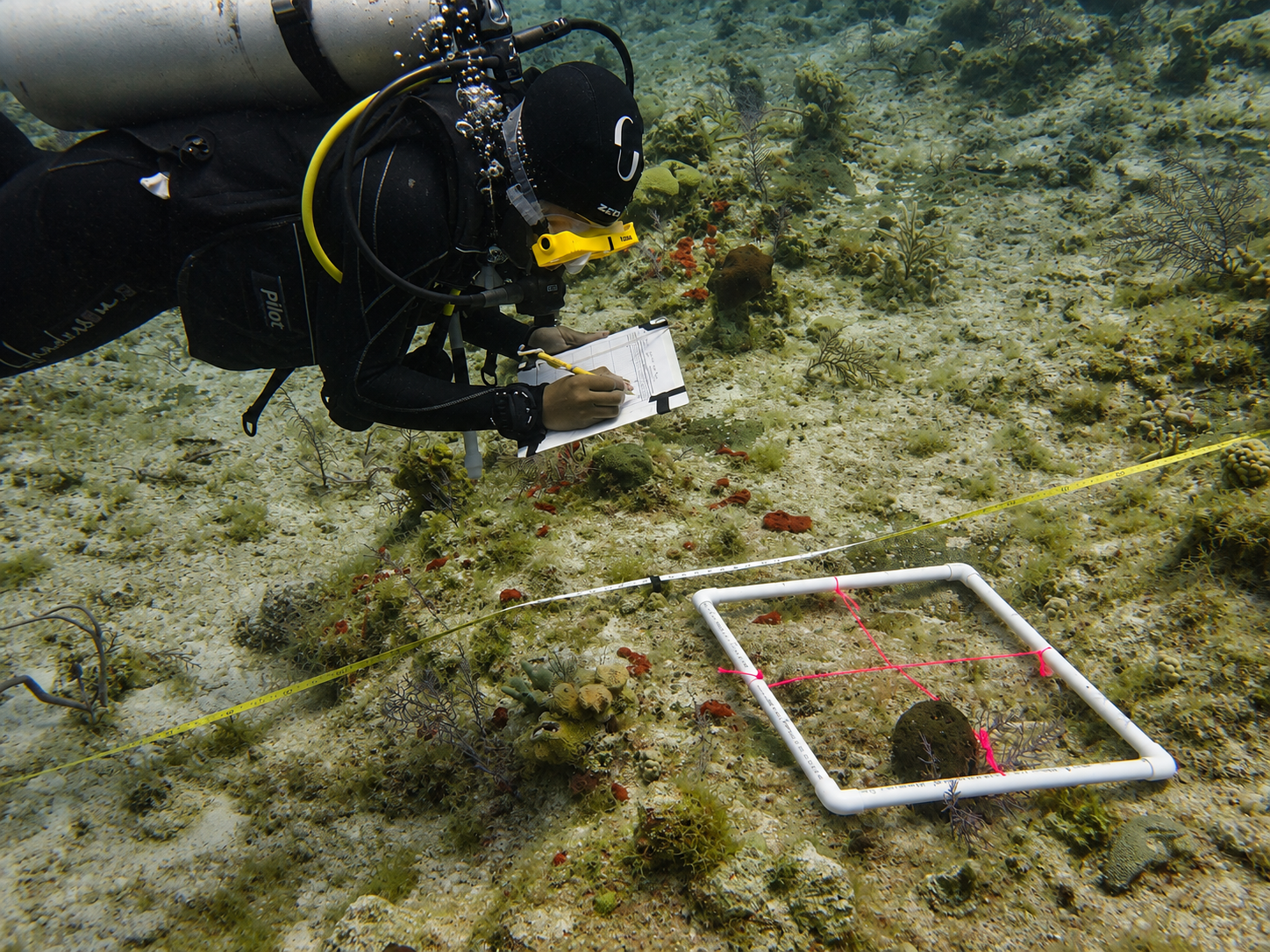
Underwater exercises introduced participants to belt transects, quadrats, visual estimates of benthic cover and quantitative reef fish surveys.
In Turks and Caicos, participants also practised fish length estimation for biomass calculations and compared alternative methods for estimating coral cover.
Survey Design and Data Management
An important component of the training was understanding how monitoring methods should be adapted to local ecological conditions, management objectives and available resources.
Participants examined sampling design, site selection, survey precision, data recording and the interpretation of monitoring results.
C3 International also introduced approaches to data management and compared GCRMN monitoring methods with the Atlantic and Gulf Rapid Reef Assessment (AGRRA) methodology.
The training emphasised that reliable, consistently collected data are essential for identifying trends in reef health and supporting meaningful conservation decisions.
Socioeconomic Monitoring and Community Engagement
On 18 March 2022, C3 International delivered a regional online workshop introducing the SocMon framework for socioeconomic monitoring of coral reef-dependent communities.
The workshop involved representatives from Anguilla, Turks and Caicos, Montserrat, the British Virgin Islands, the Cayman Islands, Bermuda and the Pitcairn Islands.
Participants were introduced to socioeconomic monitoring methods, including key informant interviews, household surveys and approaches to understanding the relationships between coastal communities and marine resources.
The workshop demonstrated how socioeconomic data can complement biophysical monitoring by examining livelihoods, resource use, cultural practices and local perceptions of environmental change.
Discussions explored the application of traditional ecological knowledge and the potential role of socioeconomic information in improving fisheries management and stakeholder engagement.
Capacity Assessment and Recommendations
C3 International used pre- and post-training questionnaires, practical exercises and participant feedback to assess improvements in knowledge and identify additional training needs.
Technical reports were prepared for JNCC, documenting training activities, participant learning, methodological considerations and recommendations for strengthening national monitoring capacity.
These recommendations addressed further practical training, survey design, data analysis, diving competency and opportunities for collaboration between UK Overseas Territories and regional monitoring networks.
Key Results
The project delivered measurable improvements in coral reef monitoring knowledge and practical survey skills.
- 22 participants trained through two five-day biophysical monitoring workshops in Turks and Caicos and Montserrat.
- 10 days of structured practical and classroom training delivered across the two territories.
- Seven UK Overseas Territories represented in a regional online socioeconomic monitoring workshop.
- 85.5% mean identification quiz score achieved by participants in the Turks and Caicos workshop, including 98.3% for reef fish and 87.2% for hard corals.
- Measurable improvements in species identification skills documented through pre- and post-workshop assessments, particularly for benthic organisms in Montserrat.
- Three technical workshop reports completed, providing evaluations and recommendations for further development of coral reef monitoring programmes.
- Increased awareness of integrated monitoring approaches, combining ecological assessments with socioeconomic information relevant to reef management.
The training also identified important capacity gaps, including the need for additional practice in underwater survey techniques, data analysis and the development of locally appropriate long-term monitoring programmes.
Lasting Impact
The assignment strengthened the technical foundations for improved coral reef monitoring across participating UK Overseas Territories.
By developing local expertise in standardised survey methods, the project helped equip government officers and other marine practitioners with skills relevant to assessing reef condition and contributing reliable data to regional and international monitoring initiatives.
The integration of socioeconomic monitoring introduced a broader approach to understanding coral reef conservation, recognising that effective management requires information about both ecosystem condition and the communities that depend upon marine resources.
The work also highlighted the importance of adapting monitoring protocols to local circumstances rather than relying on a uniform methodology, particularly where technical capacity, funding and logistical resources are limited.
While further training and sustained institutional support were recommended before fully operational long-term monitoring programmes could be established, the project provided an important foundation for future capacity development.
The assignment demonstrates C3 International’s expertise in coral reef ecology, scientific capacity building, ecological and socioeconomic monitoring, technical training and the development of evidence-based conservation programmes.
Contact:
Work with C3 International
We welcome enquiries from governments, international organisations, NGOs, research institutions and private-sector partners seeking specialist expertise in marine and coastal environments.
Whether you are developing a new project, seeking technical advice or exploring opportunities for sustainable blue finance, we’d be pleased to discuss potential collaborations.
C3 International Limited is registered as a Limited Company in England and Wales, registration number 11233261